Falling Between the Cracks of Law: Legal Protection & Advocacy for Local Staff
Authored by: Sara de Jong, Professor in Politics, University of York | Co-Chair, LSI and Betsy Fisher, U.S. Immigration Attorney and Advocate | Lecturer, University of Michigan Law School
Local staff often face similar exposure to danger and trauma as internationally deployed armed forces, yet they receive significantly fewer protections. Unlike humanitarian workers and journalists, who enjoy protected status under international law, local staff do not. All too often, they fall between the cracks of different bodies of law.
A Landmark Mapping of Legal Advocacy
This is the first report to systematically map the legal advocacy strategies and judicial challenges brought on behalf of local staff across nine countries/regions: Australia, Canada, France, Germany, the Netherlands, Sweden, the United Kingdom, the United States, and the European Union.
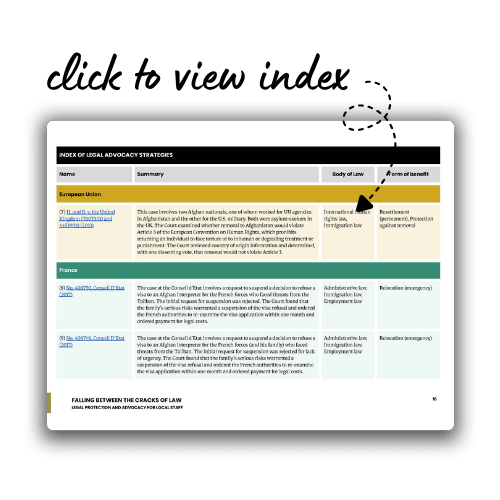
The report includes a searchable Index of more than 60 legal cases (2009 to 2025) with English case summaries and links to original court judgements. Interviews with local staff and advocates, desk research, and the authors’ own expertise as practitioners informed the Index.
The report examines where existing legal frameworks have offered protection, where they have fallen short, and what a more durable international standard must address.
Three Interconnected Areas of Focus
Specifically, the report covers three interconnected areas:
- Which law applies, the employer country’s or the local staff’s home country, and how courts have addressed this contested question
- How employment, immigration, data privacy, transparency, and criminal law have each been used to advance local staff protection
- What remedies have been secured, including cross-framework outcomes (for example, where employment and data privacy claims resulted in immigration benefits)
Companion to the Guidelines
This report serves as a companion resource to the Guidelines for the Rights and Protection of Local Staff in International Missions. While the Guidelines set out what protection should look like, this report documents how local staff, supported by legal advocates, have turned to the courts when governments failed to act, and what legal remedies have been sought, and too often denied, in practice.
Additional Resources
Additional external, open access, sources and reports can be found below.
Coburn, N. 2021. The Costs of Working with the Americans in Afghanistan: The United States’ Broken Special Immigrant Visa Process. Providence, RI: Watson Institute for International and Public Affairs
De Jong, S. 2026. ‘“The most important people here are not us – it’s those translators”: The Hidden Labor of Afghan and Iraqi Local Interpreters’. In: Interlingual Relations: Global Politics in a Polyglot World (eds. M. J. Caraccioli and E. Wigen). Ann Arbor: University of Michigan Press, pp. 234-253.
De Jong, Sara and D. Sarantidis. 2022. Divided in Leaving Together: The resettlement of Afghan locally employed staff – A comparison between Australia, Canada, Denmark, France, Germany, the Netherlands, the UK and the US. University of York: IGDC Working Paper Series, no. 2.
Distler, W. 2024. ‘Der Umgang mit unterstützenden lokalen Akteuren bei der Beendigung von Einsätzen.’ in: Die Beendigung Humanitärer Militärischer Interventionen: Wie Können Exit-Strategien Aussehen? (ed. I.-J. Werkner). Heidelberg: Heidelberger Forum zur Friedensethik, pp. 16-24.
Fahad, F., & Spijkerboer, T. 2022. De falende evacuatie uit Kabul was een voortzetting van het asielbeleid. Nederlands Juristenblad, (22), 1762-1770.
Sørensen, N. N., & Andersen, E. K. 2022. The responsibility to protect remains a challenge: The plight of the Afghan interpreters. Danish Institute for International Studies (DIIS). DIIS Working Paper, No. 11.